
A Rose of Solidarity; Bridging Western Hope and Postsocialist Doubt
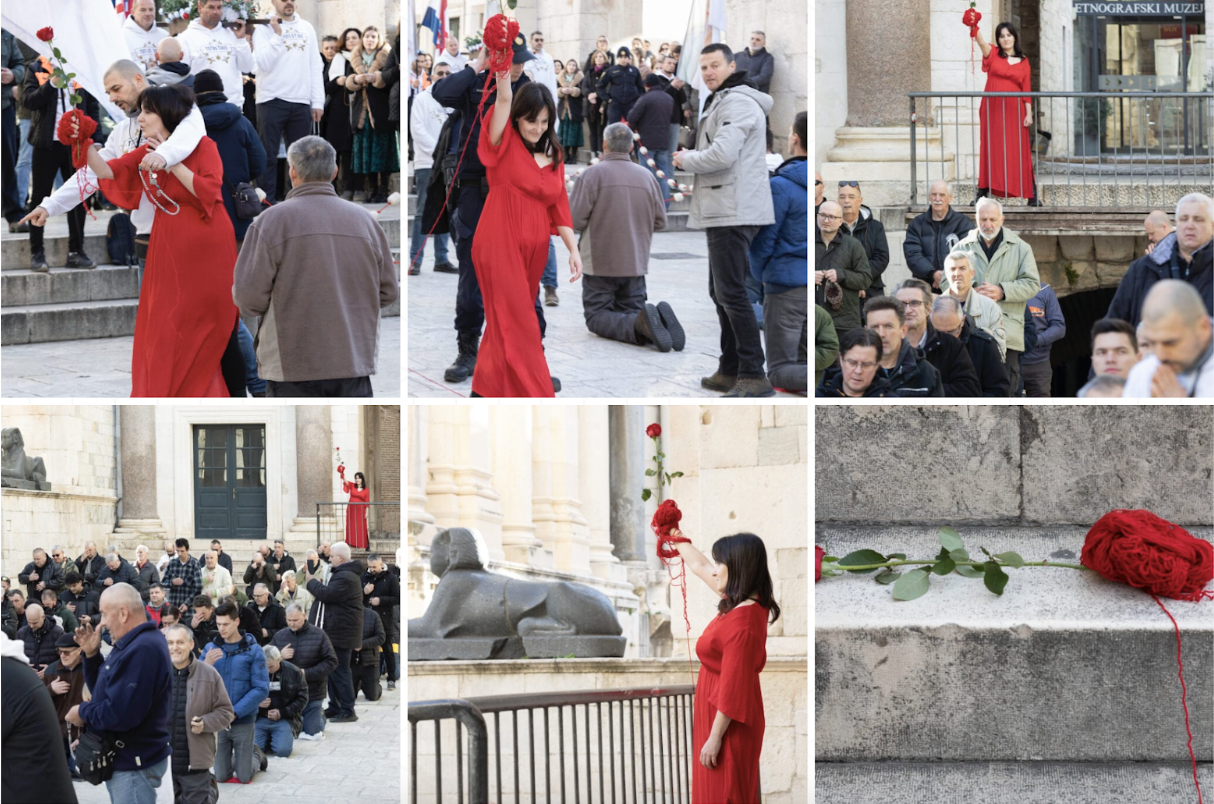
Hello, everyone. My name is Alison Stratten; I am a postsocialist scholar with a focus on social justice education, an entrepreneur, and a mom. I am here today to speak to you about solidarity and to disrupt a binary that has fueled global conflicts, permeated our discourse, and is rarely questioned, although it remains definitive in modern political debates: capitalism versus socialism. And to do all that, of course, we are going to speak about art.
On the first Saturday of every month, groups of men meet in public squares in Croatia to pray. They call themselves knights, the Knights of the Immaculate Heart of Mary, but are commonly called "klecavci," the kneelers. They pray for their homeland, strong male authority and female chastity, abortion bans, and a ban on extramarital sex; they pray for patriarchy. In response, as a collective intervention in public space, artist and activist Arijana Lekić-Fridrih created "Silent Mass," a performance in which she stands in front of these kneeling men, laying red roses and posters at their feet, disrupting their claim to power over space and women; pointing out that their prayers are not peaceful or harmless and revealing their posture as violent (Domino, 2024).
She is not alone. The Women's Network of Croatia (WNC) has called the kneelers' public prayer "retrograde, unconstitutional, and anti-civilizational" (Hina, 2023). They name the group's powerful backer, the Polish ultra-conservative organisation Ordo Iuris, which was among the mobilising forces behind the 2021 total abortion ban in Poland. The movement was imported from Poland and the United States to Croatia in 2016, which now has its own March for Life movement, an American franchise that began in 1974 after the legalisation of abortion in Roe v. Wade. Although abortion is legal in Croatia, part of the country's socialist legacy from former Yugoslavia, and has strong public support, many doctors refuse abortions due to personal religious beliefs. WNC has called for the "prayers" to be banned and organised counter-rallies as they fight for the right to abortion to be included in the Croatian constitution (Pavić, 2023). On February 3, 2024, police intervention prevented the fourteenth performance of Silent Mass. In a statement released by supporter Dominio, a non-governmental, non-profit organisation based in Zagreb, founder and curator Zvonimir Dobrović pointed to a rise in violence against women and “alarming rates of femicide” in Croatia. He called the police action in defence of the kneelers catastrophic and shameful (2024).
The first time I learned about Silent Mass, as some of you may be feeling now, I was compelled to act in solidarity with the artist and women living in Croatia. Like art, solidarity can be understood as something we make (Rorty, 1989); we may be making some here today, sharing space and ideas across different experiences and understandings, learners and academics, activists and artists, entrepreneurs, business people, and policymakers. I honour each of you for making time in your day to be here. I ask you to welcome hybridity in this space to overcome "the grounds of opposition" that may divide us (Bhaba, 1994). Solidarity requires you to see me and one another in complexity; as Audre Lorde wrote, "allow each other our differences at the same time as we recognize our sameness" (1984).
Like many settlers on Turtle Island, my grandparents came to Canada from Eastern Europe, seeking safety and opportunity. My paternal grandfather Morris was born in Anikst, Lithuania, in 1902. A "card-carrying Communist," as my father described him, a teacher who fled violence and opened a convenience store in Montreal with my grandmother, Nina. I was born in 1976, and as a white, cis-gendered woman have benefitted from the rights secured through feminist struggle, built overwhelmingly on the resistance, scholarship, labour, and community building of Black, Indigenous, and women of colour, Queer, particularly transgender women, and disability activists. My experience under capitalism has been overwhelmingly shaped by privilege.
I became a mother at 26, just as I was completing my undergraduate degree in Social Work from McMaster University and working as a co-op student for Toronto City Councillor Joe Mihevc. It was 2002, and like my son Jakob, now also a student at the University of Toronto, the social capabilities of the internet were in their infancy. Motherhood did not change me so much as it recategorized me as a new type of woman. Suddenly alone, at home with an infant in our little apartment at Eglington and Avenue Road, I found community online and fell madly in love with the internet. After Jakob's siblings Alex and Tessa arrived, I founded a maternity lingerie company called Nummies. Web 2.0 had given rise to blogging and social media, and I used my love of writing and experience with community organising to keep myself in business, becoming part of a growing movement of content and relationship marketing. Like parenting, entrepreneurship was isolating. Through social media, I found a virtual water cooler, connecting with entrepreneurs in my town and around the world. I met my future partner Scott, and after a merger, we blended families and I welcomed my two oldest children, Aidan and Owen. Together, we authored books and travelled worldwide, sharing marketing, branding, sales, and leadership best practices in the age of digital disruption. To ensure my work was done with a social justice lens, in 2020, I returned to school to pursue my master's and doctoral studies at OISE. I am probably the only postsocialist scholar in the world whose claim to fame is that Martha Stewart once followed her on Twitter.
Breaking binaries requires breaking illusions, which can be uncomfortable work. However, solidarity rests on our ability to critically engage with our biases to move beyond "the articulation of well-founded possibilities" (Friere, 1997). Queer Chicana poet, writer, and feminist theorist Gloria Anzaldúa warned that "rigid borders hinder communication and prevent us from extending beyond ourselves." "Cultural ideas," she wrote, "(such as what's honourable or cowardly, manly or womanly) and their taken for granted truisms are imbibed at a young age and become life's givens, a familiarity that makes us feel secure. It can be hard to adopt new ideas and new ways of seeing, especially if these new perspectives seem threatening and make us doubt or distrust our core sense of self" (2017). I am a postsocialist scholar, entrepreneur, and mom, a proud part of this beautiful institution, the very product of capitalism and neoliberalism. I am also a woman whose work aims to retether the academy to the local; a citizen and activist who supports the reclamation of public goods (including my beloved internet) and free, accessible education, health care, and housing. I am someone who, echoing the words of the Combahee River Collective Statement, is not convinced "that a socialist revolution that is not also a feminist and anti-racist revolution will guarantee our liberation" (1977). I sit in this position in discomfort and, hoping you will join me, seek something new.
Art tells a story and shares something otherwise impossible to communicate; a human narrative tied to the artist's intention, uniquely rooted in identity, place, and history. Art is often at the forefront of social movements and revolutions, with the social power of activist artists emanating from their ability to provoke new consciousness, new ways of being, acting, and understanding the world and our place within it (McCaughan, 2012). Equally enjoyed, feared, disputed, and banned, sometimes simultaneously, art can "subversively reverse the hierarchies found within binary concepts and challenge the hegemonic order" (Manning, 2022). The red rose Lekić-Fridrih lays at the kneeler's feet has been a symbol of socialism since the late 1800s, tied to anti-authoritarianism and resistance movements. Today, the red rose is a common addition to left-leaning social media profiles and is used globally to represent the social democratic movement. In media representations, from music to visual art and advertisements, the red rose is often a gendered symbol of love, a gift from a devoted man to a grateful woman. Lekić-Fridrih's act is one of reclamation, in which she can grasp the rose and all it represents and lay it at the feet of patriarchy. Her act itself embodies the equality socialism promised women - not held in the realm of national messaging and mythology - but actualized by one woman, addressing a group of men longing to dehumanise her.
Like many of you, capitalism is the water I have always been swimming in; an economic system within which the bulk of the means of production is privately owned and controlled; people legally own their labour power, and markets are the main mechanism for allocating inputs and outputs of production and determining how surplus is used. The class division between capitalists and workers shapes our labour market, the workplace, and our broader political process. Production is primarily oriented toward profit rather than meeting human needs. Having arisen as a critical challenge to capitalism, socialism is best defined in contrast - a society where the bulk of the means of production is under social, democratic control. To combat state power, socialism calls for the expansion of social power, based on the capacity to mobilise cooperation and collective action, and shifts economic power, based on the control of material resources, to the people. Socialists critique capitalism's features of exploitation, domination, alienation, and inefficiency while promoting principles of equality, democracy, community, and solidarity, as capitalists critique socialism for limiting capitalist activities (Gilbert & O’Neill, 2019).
Under capitalism, cultural production seeks profit; talents become marketable skills; artists turn their eyes to graphic design, and authors answer to publishing houses that make choices based on the profitability of their words. When poet laureates and national galleries present images of belonging and identity, these too become geared to profit on Tim Hortons' cups, in hockey commercials, and as part of an enduring Canadian national mythology (Haque, 2012); encouraging investment, inviting newcomers and visitors, and positioning Canada on the international stage as a multicultural, progressive nation. Within the context of state socialism, profit did not matter, and so cultural production focused entirely on promoting socialism and socialist values. These two economic systems became two kinds of cultures set in opposition on the world stage. Capitalism versus socialism became a powerful story, framing and reflecting our understanding of ourselves, the world, and our place within it (Hampton & DeMartini, 2017). Socialist states in Eastern Europe and the Balkans with "streamlined and overtly rational modernity" produced "a communism whose cultural and economic essence was its refusal to satisfy human needs" (Todorova, 2021). This "dictatorship over needs" (Bauman, 2010) deprived socialist subjects of "both material and emotional choices, including choice over the kind of person one wishes to be" (Todorova, 2021). At the other end of our spectrum, Western capitalism turned "consciously, explicitly and joyously to the production of new needs" (Bauman, 2010), with the proliferation of needs and choice redefining human happiness as one's capacity to consume.
While helpful in considering the qualities and mechanisms of each system, the binary of socialism versus capitalism erases cross-cultural exchanges (Todorova, 2021). Pervasive discourse framed the Communist Party as omnipresent, an "iron curtain" preventing Western, specifically American media and culture from reaching socialist subjects. However, research reveals this was a myth, describing it as a "nylon curtain" through which American influence never waned, despite attempts by the state to prevent it (Volf, 2021), spreading, in both directions, “visions of a ‘good society’ of ‘humanism’ as well as of civil, political, and social citizenship” (Péteri, 2004). Furthermore, the binary is maintained by knowledge production that privileges a Eurocentric understanding of socialism, when in reality, a variety of “lived socialisms” (Todorova, course syllabus, 2024) have been mechanised in Africa, Asia and Latin American contexts; in some serving as a vehicle of anti-imperialist purpose (Da’na, 2019; Ratner, 2021), and in others acting as a mechanism to further colonial projects (Jovic, 2008). Scholarship in Africa, has asserted that socialist ideas and practices were evident before colonisation, known as culture rather than philosophy. The conceptual introduction was a revolutionary idea that fueled an existing cultural conviction; defining “African socialism as an attempt to recapture and modernise the communal way of life practised by the traditional African before the contact with the world and values of the white man” (Yacouba &Wologueme, 2018). Beyond the binary lies knowledge found in the complex intersections and influences of communism, confucianism and modernization in Vietnam (Gross, 2015), the impact of decentralised feminist strategies utilised in Nehru’s India (Sherman, 2021) and the influence of both capitalism and industrialism, and the human cost, of the extraordinary results of state socialism in North Korea (Kim, 2014).
Capitalist or socialist, behind the facade of national messaging, lay social, economic, political and cultural realities; to enact policy and maintain control, the state engages in violence. In Canada, our violent history and ongoing settler colonialism lies behind the story of a multicultural, bilingual nation, solidified in part by the 1969 Royal Commission on Bilingualism and Biculturalism, which set the frame of reference for Canada as a settler state founded by two white nations (Haque, 2013). Those in power mobilised expert knowledge to confirm the argument that immigrants chose, fully informed, to come to Canada and, in so doing, forfeited all rights to cultural preservation. To this day, the title of immigrant is a social construct in a state where "identification in Canada is a factor of race and the privilege attached to whiteness" (Madibbo, 2013). In Russia, Indigenous populations have living standards below the rest of the population, with national languages endangered and several nationalities driven to extinction. Once independent of the Russian state, the Indigenous population was integrated into Tsarist Russian society, preserving their subsistence systems and traditional administration. However, later, during the Soviet period, Indigenous nations were integrated into Soviet society by force, and traditional subsistence systems were destroyed (Diatchkova, 2001).
State socialism was marked by a paradox between ideological commitment and practice; between messaging and lived experience. The concept of race was muted “by ideological and cultural discourses'' (Todorova, 2021) and elided as a meaningful or analytical category, leaving marginalised populations tolerated only to the degree where they would not threaten dominant hegemony (Tlostanova, 2010). In Cuba, where there has been a fifty-year, uninterrupted period of political commitment to anti-racist strategy, state policy and discourse simply ignored the issue of racism; a denial maintained today in many positions of authority. Rhetoric and state messaging alone could not shift entrenched racial hierarchies in Cuba because, similarly to state socialism in Eastern Europe and the Balkans, the initial phase of championing equality and desegregation, was followed by a much longer period of denial and silence (Law, 2012).
Rather than disrupt the hierarchies many of us seek to disrupt, where white, European men are the ideal against which everything else is meansured, these formations were built into socialist ideology. People and cultures that were deemed different, “were assigned meaning, value, and location within material and symbolic socialist hierarchies of desired and undesired subjects framed as either advancing or inhibiting the objectives of socialism and communism” (Todorova, 2021). Under socialism, the state claimed ownership of concepts of gender, seeking to build up socialism by building up a new man who would be "morally healthy, selfless and consider work their greatest honour and pride." Non-normative sexualities were criminalised because of growing concerns to suppress forms of sexuality not linked to procreation and building state socialism. Criminalization, a lack of private space, and the blackmailing potential of every citizen established an awareness of being permanently visible, preventing most Queer people from establishing a sustainable life with a partner (Takács et al.,2017). Similarly, motherhood belonged to the state, and women who chose to deviate from this national mythology were seen as violators of both socialist morality and traditional morality for their failure to adhere to hegemonic gender roles (Hearne, 2022).
Still, many hold tight to a belief that socialism liberates women, perhaps evoking Hugo Chavez, 21st-century socialism, and the Bolivarian nationalist project. According to Chavez, new socialism would be different from state socialism practised in Eastern Europe because it would be more pluralistic and less state-centred (Wilpert, 2007). His death was considered a blow to the movement's progress, particularly to women who benefited from social programs and legislation supported during his leadership (Fox, 2013). Chavez calling himself a feminist and supporting women in leadership did indeed open up possibilities. However, by focusing discourse on Chavez, we erase the labour of feminist collectives in the name of creating a narrative of one mythical man. Seventy percent of the people participating in the Venezuelan government missions are women, who comprise communal councils, grassroots movements, and feminist groups working across the country. Despite all this labour and the influence of Chavez, machismo, patriarchy, and individualism maintain a powerful grip over the country (Fox, 2013). Venezuelan advocacy groups say the government is feminist in name only, having done nothing to guarantee women's political participation and economic independence. By refusing to challenge patriarchy and the pervasive influence of church dogma, the state offers women liberation only insofar as they do not disrupt hegemonic gender roles, evident in silence on abortion and one of the highest rates of teenage pregnancy in Latin America and the Caribbean (Mirochnik, 2018). Progress in the realm of law and policy in socialist states has not led to social emancipation and safety for women.
Accepting the rose offered by Lekić-Fridrih requires us to recognize the commonality of women's experiences under patriarchy; however, solidarity based on our sameness is not enough. Consider the artist's use of Catholic mass. Western feminist discourse positions the Catholic Church and its doctrine as the antithesis of liberatory ideals. Within its framework, equality, and empowerment are gained through capitalist means alone. In socialist states in Europe and the Balkans, leadership targeted religion and spirituality, believing secularisation was key to achieving class consciousness and igniting a "socialist revolution" (Todorova, 2019). In her performance, however, Lekić-Fridrih’s act is again one of reclamation, in which her prayers and those of women of faith are made tangible - not held in the realm of church dogma and mythology - but actualized by one woman addressing a group of men longing to dehumanise her. The artist's use of Catholic Mass in this way represents our difference; "that raw and powerful connection from which our personal power is forged" (Lorde, 1984).
State socialism lives in the collective historical memory of Croatian citizens, shaping perspectives and actions in present times (Hobsbawm and Ranger 1983). Movements like the kneelers emerged through backlash arguments that blame women's emancipation for social problems and the emasculation of men and seek to restore patriarchal privileges (Breines et al., 2000). In Unequal Under Socialism, postsocialist scholar Miglena Todorova highlights that much feminist writing and politics emanating from the West relies on "Marxist epistemologies extensively to critique and grasp the intertwined local, national, and global aspects of capitalism and its effects on women, especially women of colour. This epistemological practice has not been questioned from the perspective of that important feminist realisation that one woman's empowering and liberating epistemology could be another woman's site of violence, oppression, inequality, and deep doubt" (Todorova, 2021).
Outside of the space we created here today, there is much work to do. In every country and culture, violence against women is pervasive and endemic (WHO, 2021). Fascism and the far right are on the rise, as neoliberalism astutely uses nationalism and religious fundamentalism to divert attention from its failings with anti-feminist messages, moral panic, and culture war rhetoric. Climate change is forcing us to have new conversations about natural resources as they become more scarce and unpredictable. Part of the resurgence of socialist political ideals in the West is that they inspire hope; that through their application we can imagine solutions to the effects of neoliberal capitalism. This hope however, remains trapped in a false binary that limits our political imagination. In response to the Bolshevik seizure of state power during the Russian Revolution and the violence it entailed, Anarchist Emma Goldman wrote, "means employed become, through individual habit and social practice, part and parcel of the final purpose; they influence it, modify it, and presently the aims and means become identical…To-day is the parent of to-morrow. The present casts its shadow far into the future. That is the law of life, individual and social. Revolution that divests itself of ethical values thereby lays the foundation of injustice, deceit, and oppression for the future society. The means used to prepare the future become its cornerstone" (1923). As we gather in a place where we love to debate big ideas, we should remember that ideologies and metaphors have never kept us safe. Rather, it is within our collectivities, as Angela Davis wrote, that “we find reservoirs of hope and optimism” toward liberation (2015). Solidarity is something we make when hope and doubt meet, not as rivals, but as radical collaborators. Only then, together can they ask, “How do we build a just world, protect our planet, and preserve our humanity, unifying our ends with our means?”
I am here today to disrupt one story in the name of thousands of others. To ask you to consider how you know the things you do and who is served by your commitment to that knowledge; to offer critique in the name of opening up “space of translation” (Bhaba, 1994).
I do so in the name of another kind of hope; that found in the narratives of women. My hope is that of a survivor, who like many children learned about love alongside fear and violence and never had the privilege of myths. It is fueled by the stories of women across time and place, who do what they can with what they have. Who seek beauty and spirit, who live despite obstacles and through all manners of horrors; who resist and in so doing liberate themselves and light the way for others. When you live in fear, you do not care if relief comes inspired by parables, Marx or the bottom line. In every country and culture, violence against women is pervasive and endemic (WHO, 2021). Hope does not lay in ideology; like art and solidarity, hope is something we have to make.
Every Saturday in Croatia, Arijana Lekić-Fridrih risks her safety to assert her human rights and access to public space. She is part of a movement of Croatian feminists who demonstrate courage, determination, and a commitment to fight for the hard-earned rights of women. Today, as learners and academics, activists and artists, entrepreneurs, business people, and policymakers in this space, I ask you to make room for Silent Mass and the women of Croatia beyond binaries that work to keep us apart; to take what you have learned in this room, and bring it with you out into the world. I ask you to do what you can, with what you have. Make art. Make policy. Make safety for those around you. Make solidarity. Make hope.
Thank you.